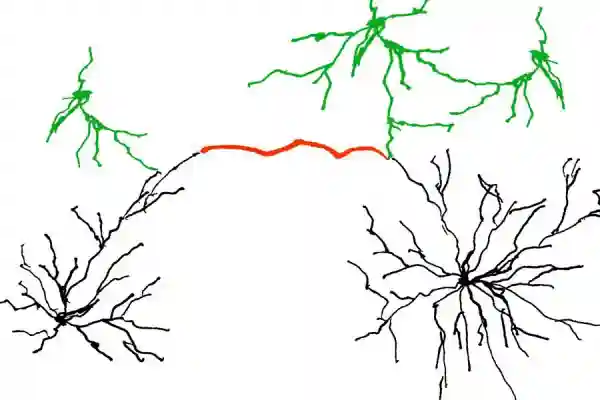
 Brain Model
Reflection or Rumination – When Revisiting the Past Helps and When It Doesn't
Both reflection and rumination revisit the past. Both involve the same hippocampal memory system, the same mPFC self-reference circuitry, the same amygdala emotional tagging. What makes one adaptive and the other a loop that does not resolve is not the content of the episode, not the time spent on it, and not the person's willingness to think carefully. It is whether new context reaches the vmPFC during the process.

Anatomically and biochemically
Adaptive reflection and stuck rumination share the same starting circuit. The hippocampus retrieves an autobiographical episode. The mPFC relates it to the self. The amygdala applies its emotional valence. The ACC monitors whether the episode has been resolved. Up to this point, the two processes are identical. The difference lies in what happens next.
In adaptive reflection, new information enters the circuit. This can come through conversation with another person (who provides an external perspective not present in the original encoding), through writing (which externalises the episode and creates a version the mPFC can evaluate from a slight distance), through the passage of time combined with new life experience (which the vmPFC can use to form new associations around the episode), or through explicitly linking the episode to a wider context or pattern. Whichever route this new information takes, it reaches the ventromedial prefrontal cortex (vmPFC) – the structure that forms new associative connections around stored episodes and modulates their emotional meaning.
When the vmPFC receives new context, it forms new associative links around the memory. During the next reconsolidation window – the brief period of lability that opens each time the memory is retrieved – these new associations are incorporated into the re-stored memory. The emotional valence of the episode shifts slightly. The ACC's open-loop signal receives partial satisfaction: new information has arrived, even if the episode cannot be changed. Replay frequency decreases. The episode begins to integrate into the broader autobiographical narrative rather than sitting as an isolated, emotionally charged object.
In stuck rumination, no new context reaches the vmPFC. The circuit runs: hippocampus retrieves → amygdala re-applies emotional charge → mPFC anchors to self → ACC registers as still unresolved → hippocampus retrieves again. The loop is closed. The same emotional encoding is re-consolidated with each cycle. The episode does not become less present; it becomes more deeply encoded, and the neural pathway for its retrieval becomes more efficient. The metaphor here is not a wound that heals through attention: it is a path that deepens with every step taken along it.
The practical implication is not "think less about the past" – it is "bring new context." Writing about an episode in third-person rather than first-person activates slightly more regulatory prefrontal processing. Narrating an episode to another person introduces their perspective into the vmPFC's associative space. Returning to an episode after time has passed with genuinely new information allows the vmPFC to form connections not possible at the time of the original event. The skool.com/supervision community provides a structured context for this kind of processed reflection in professional settings. The Self-Critical Inner Dialogue map describes what happens when the mPFC's self-referential processing turns evaluative and negative rather than integrative.
Everyday examples
- The conversation that changes how a conflict feels: A manager discusses a difficult exchange with a trusted colleague. The colleague provides a context the manager had not considered. The vmPFC receives genuinely new information. The next time the episode comes to mind, its emotional charge is slightly different. Replay frequency gradually decreases.
- The journal entry that loops: Someone writes about the same difficult episode every night for a week, in first-person, focusing on what they should have done differently. No new context is introduced. The writing is a more elaborate form of rumination, not reflection. The ACC's open loop remains open; the episode does not integrate.
- The episode that resolved without effort: Six months after a difficult professional moment, a new situation provides context that reframes what happened. The vmPFC connects the old episode to the new information. The next time the memory appears, it carries less charge than it did before. No deliberate processing was required – the new context was sufficient.
What this page does not say
This page does not recommend specific therapeutic approaches or techniques. It describes the neural distinction between adaptive and non-adaptive memory processing in the healthy brain. It does not say that all reflection is adaptive or that any particular activity will reliably shift emotional encoding. Persistent, distressing rumination that does not resolve over weeks and accompanies other signs warrants professional assessment. This page is not a diagnostic instrument and not a treatment guide.
Frequently asked questions
What is the difference between reflection and rumination?
The circuit difference is whether new context reaches the vmPFC during processing. In adaptive reflection, conversation, writing, or new experience introduces information the vmPFC uses to form new associations around the memory. The emotional encoding shifts during reconsolidation. In rumination, no new context enters. The same episode replays, the same emotional charge is re-encoded, and the ACC registers it as still unresolved.
When does thinking about the past help?
Thinking about the past helps when it introduces new context – a different perspective, a broader framework, a piece of information that was missing. This new context reaches the vmPFC, forms new associations around the episode, and shifts its emotional valence during reconsolidation. Replay frequency then decreases and the episode integrates into a broader autobiographical narrative. When revisiting produces only the same emotional charge, no new associations are forming.
Is thinking about the past bad for you?
Not inherently. Revisiting the past is a normal function of the autobiographical memory system. The relevant distinction is whether the revisiting adds new context or replays the same pattern. Adaptive reflection integrates experience and decreases replay frequency. Stuck rumination maintains the same emotional encoding and keeps the open-loop signal active. The same neural resources produce different outcomes depending on the direction of processing.
Search interest in this topic
Global monthly search volume – "difference between reflection and rumination": {{AHREFS_VOLUME}}
Global monthly search volume – "when does thinking about the past help": {{AHREFS_VOLUME_2}}
Co-occurring terms in top-ranking content: {{COOCCURRENCE_TERMS}}
These are estimates of observed search behaviour, not clinical prevalence data.