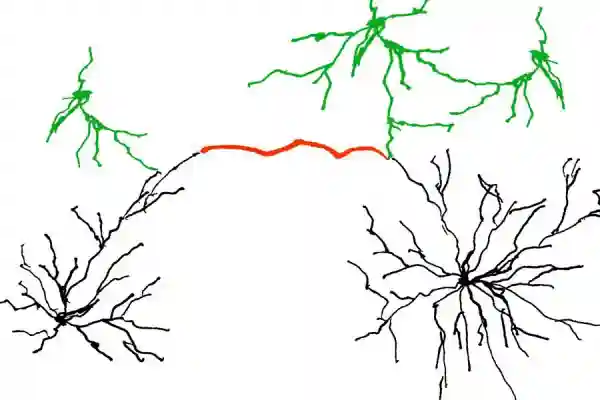
 Brain Model
Map 02 – Self-Devaluation in Thoughts
What happens in the healthy brain when someone devalues themselves – in thoughts, in inner judgements
Anatomically and biochemically
When someone devalues themselves in thoughts – in thoughts, in inner judgements (co-occurrences: self-criticism, negative self-talk, inner blame) – a precise neural sequence unfolds. The trigger is often an internal or external moment of comparison: a situation, a memory, a glance at others. The amygdala classifies the signal as a personal threat. Simultaneously, the insula activates the bodily experience of the devaluation – a diffuse sense of pressure, a tightness in the chest, a sinking of energy. This happens before the first thought is formulated.
The medial prefrontal cortex (mPFC; also known as the self-referential area, medial PFC) is always active when thinking about oneself. In combination with the subgenual anterior cingulate cortex (sgACC) – a region that shows above-average activity during sustained negative self-evaluation – an evaluation loop forms: mPFC formulates the self-reference, sgACC weights it negatively. The result reaches the amygdala, which marks the self-image as threatening and initiates further stress responses. Glutamate and cortisol amplify excitation. The insula reports the bodily correlate: self-devaluation is never merely a thought – it always has a somatic expression.
The habenula (part of the epithalamus, counterpart to the mesolimbic dopamine system) inhibits the dopaminergic projections from the ventral tegmentum that supply the striatum. The result is an actively suppressed reward system. The person does not experience pain in the classical sense – but an absence of drive, pleasure, and motivation. With repeated activation of this loop, the hippocampus consolidates the circuit during sleep. What begins as an inner sentence becomes a structural pattern. The bypass via the Default Mode Network can interrupt this loop – not through contradiction of the self-devaluation, but by activating a different self-referential mode.
Everyday examples
- After a mistake: Thoughts such as "that's just who I am" or "I'll never learn" activate the mPFC-sgACC circuit. The generalisation to one's own person – rather than the specific situation – is neurobiologically costly.
- In comparison with others: "They can do that, I never could" – the moment of comparison triggers amygdala and insula simultaneously. The brain treats perceived inferiority as a threat.
- In preparation: "I will embarrass myself" before a presentation keeps the sgACC-amygdala loop active, producing precisely the exhaustion one wanted to avoid.
- In the evening review: Ruminating over one's own mistakes from the day activates the same circuit – and the habenula inhibits the reward system that should be preparing for sleep.
- Automatic reaction to praise: A calibrated habenula system can mean that recognition, when it arrives, is no longer experienced as reward. The striatum responds in a dampened way.
What this map does not say
This map describes a normal mechanism in the healthy human brain. The mPFC-sgACC circuit is active in all people – it is not a sign of illness. Sustained and intense overactivation of the sgACC is a well-established finding in depressive disorders – that is not what this card describes. This map is not diagnostic and not a treatment recommendation.